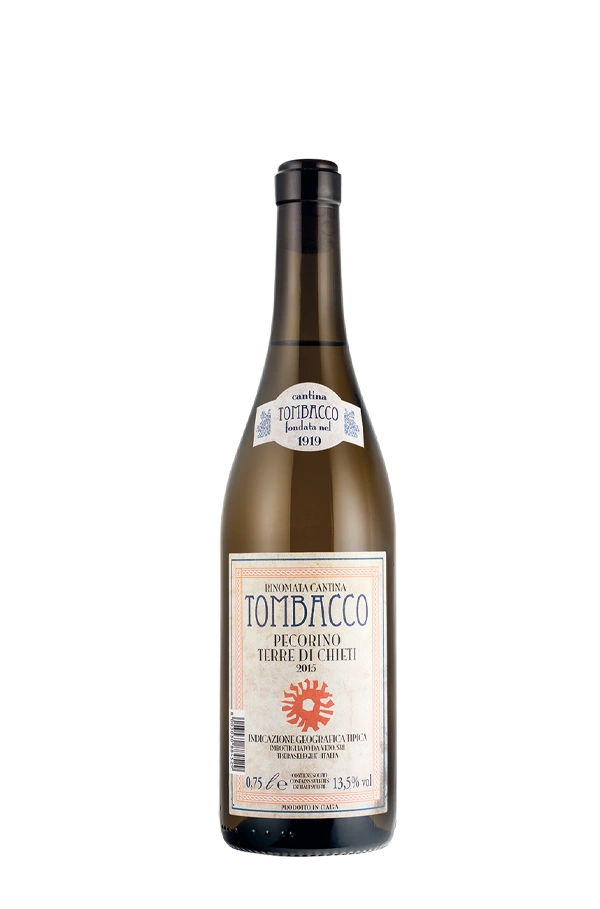

There are wines that introduce themselves through fame, and others that invite us to take a slower, more intimate road: Pecorino white wine belongs to this second group.
Its story moves through central Italy, from mountain landscapes to the gentle hills of Abruzzo, where vineyards lie between the Apennines and the Adriatic sea. It is a white wine with a distinctive identity: fresh yet structured, savory, aromatic. A perfect mirror reflecting the fascinating contrasts of its territory.
For international wine lovers, buyers, and restaurant professionals, Pecorino is also a reminder of how much diversity exists beyond Italy’s most familiar labels.
Within the Cantina Tombacco 1919 Group, this wine is part of the Rinomata Cantina Tombacco range, shaped by an ongoing search for quality, the selection of carefully chosen grapes, and the exploration of Italy’s most distinctive wine-growing territories.
This philosophy reflects our group commitment to bringing forward Italian wine excellence through wines that express the identity, diversity, and character of their place of origin.
The result is a Pecorino IGT Terre di Chieti that brings together the character of an ancient grape and a clear, contemporary style: a jewel worth rediscovering.
What is Pecorino white wine?
Pecorino is a white grape variety from central Italy, strongly associated with Abruzzo and some areas of the neighboring Marche region.
Why is it called Pecorino?
The name Pecorino recalls a connection between wine and sheep–rearing, since in Italian the word pecora means sheep. This has long inspired popular stories, particularly those linked to transhumance.
According to the best-known version, flocks traveling through mountain areas were attracted to the ripe grapes. However, the precise origin of the name is still debated.
Some historical and linguistic interpretations question the traditional pastoral explanation and connect the name to older local terminology and to the lively, almost piquant character traditionally associated with the wine. For this reason, the story of Pecorino is not only a winemaking story, but also one of language, local memory, and rural culture.
What is less controversial is the grape’s long presence in central Italy: around 1200 the Benedictine monks of the convent of Arquata del Tronto reportedly appreciated this vine as a generous gift from the earth, capable of producing a noble wine, suitable for important occasions.
Over time, Pecorino became part of the winemaking culture of central Italy, spreading from the Apennine foothills toward the gentler landscapes of Abruzzo and the province of Chieti.
After a period in which it had become far less common, today Pecorino white wine benefits from a modern rediscovery. This renewed attention is partly due to its features: a well-balanced meeting between freshness and substance.
Depending on the vineyard and winemaking approach, it can show:
- Vibrant acidity, which gives the wine freshness and energy without making it feel thin.
- A pronounced mineral and savory profile, particularly in wines grown on clay and limestone soils.
- Good aromatic intensity, often expressed through fruit, floral, herbal, or delicate spicy notes.
- Structure and persistence, which allow it to accompany a complete meal rather than only an aperitif.
Pecorino in Abruzzo and the province of Chieti
Abruzzo offers a particularly fitting environment for this variety, shaped by the meeting of mountains, hills, and the Adriatic Sea.
In the province of Chieti, clay and limestone soils, good ventilation, and the influence of both the Apennines and the coast help white grapes retain freshness while developing concentration and character.
The Abruzzo and Molise wine region represents one of the Italian territories selected by Cantina Tombacco 1919 Group for its strong wine-growing identity and the quality of its native grape varieties. Here, Pecorino grows in a landscape in which sea breezes, inland hills, and mountain temperature variations contribute to a distinctive balance between acidity, structure, and aromatic definition.
The selection of wines from regions such as Abruzzo reflects the group’s broader aim: to identify highly suited territories and enhance the diversity of Italian winemaking through authentic and recognizable expressions.
The importance of Pecorino in Abruzzo is also reflected in regional data. According to the Abruzzo Region’s 2026–2028 operational plan Pecorino covered approximately 1,939 hectares, equal to 5.77% of Abruzzo’s total vineyard area. It is therefore one of the most significant white grape varieties cultivated in the region, after the two main Trebbiano varieties.
The same source identifies Germany, the United States, and Canada as the main international markets for Abruzzo wines, accounting respectively for 23%, 20%, and 10% of regional exports.
These figures concern Abruzzo wine as a whole rather than Pecorino alone. Nevertheless, they help explain why regional Italian white wines with a recognizable identity are becoming increasingly relevant for international portfolios, including those targeting extra-European markets such as the United States.
For us, Pecorino fits naturally into a philosophy based on exploring Italy through its regions and grape varieties.
Our regional Italian wine selection brings together wines with different origins and personalities, united by careful research and a strong international outlook.
Is Pecorino wine dry or sweet? Here’s what it tastes like
Pecorino wine is generally appreciated for the way it balances aromatic personality, acidity, and structure.
It is usually dry, with a fresher and more savory profile than its name might suggest to someone encountering it for the first time.
Of course, no two Pecorino wines taste exactly the same. Vineyard location, ripeness, soil, fermentation, and aging all influence the final result.
In the case of Rinomata Cantina Tombacco’s Pecorino IGT Terre di Chieti, the style is defined by the following characteristics:
- Color: an intense, bright yellow with a luminous appearance, anticipating a rich and clearly defined aromatic profile.
- Aroma: complex and expressive, with notes of exotic fruit accompanied by delicate spicy hints.
- Taste: structured and savory, supported by good acidity, marked mineral notes, fruity returns, and a persistent finish.
- Serving profile: 13.5% alcohol by volume, with a recommended serving temperature of 50–54°F, corresponding to 10–12°C.
This combination of acidity and body is one of Pecorino’s most interesting qualities.
The acidity gives the wine energy and clarity, while its structure provides enough depth to remain present alongside food. Mineral and savory sensations add definition, while fruit and subtle spice make the aromatic profile immediately recognizable.
Why Pecorino is interesting for international markets
For international buyers, distributors, and hospitality professionals, Pecorino can represent an appealing alternative within the Italian white wine category.
It is distinctive enough to communicate a genuine regional story, yet accessible and versatile enough to be introduced to consumers who may be discovering the grape for the first time. Its name can create initial curiosity, but its value extends well beyond novelty.
Moreover, pecorino offers the profile expected from a food-friendly white wine together with a degree of body, persistence, and aromatic complexity that can support a broad range of dining occasions.
What foods pair well with Pecorino wine?
The best Pecorino wine pairings reflect its defining qualities: freshness, savory structure, mineral notes, and persistence.
These elements make it particularly suitable for dishes that require a white wine with more presence and personality than a light or neutral style.
Recommended pairings include:
- Seafood appetizers: the wine’s acidity and savory character support delicate marine flavors without overwhelming them. Its aromatic intensity also adds interest at the beginning of a meal.
- Grilled fish: the structure of the wine matches the firmer texture and more pronounced flavors created by grilling, while its freshness keeps the pairing balanced.
- Simple white meats: preparations without rich or elaborate sauces allow the wine’s fruit, spice, and mineral notes to remain clear, while its body provides enough weight for the pairing.
These combinations also show why Pecorino works well in different dining contexts. It can open a meal with seafood, continue alongside a main course of grilled fish, or accompany a simply prepared white-meat dish.
In restaurant wine programs, it can therefore occupy a versatile position between lighter aperitif-style whites and fuller, more structured wines.
How to serve Pecorino wine
When the wine is served too cold, some of its aromatic complexity and texture may remain hidden. At the correct serving temperature of around 50–54°F (10–12°C), instead, it retains its freshness while revealing more clearly its exotic fruit, delicate spice, and mineral character.
Pecorino finds harmony in contrast: between mountains and sea, freshness and structure, memory and modern rediscovery.
It is a fascinating stage in Cantina Tombacco 1919 Group’s journey through wine regions, cultures, stories, and traditions, revealing the richness of Italian wine diversity.
Would you like to taste our Pecorino IGT Terre di Chieti? Contact us and request a sample: we export it worldwide as part of our extensive Italian wine portfolio.